Home › Learn › The Whiff Breath Protocols
The Whiff Breath Protocols: One Breath Per State
A Whiff breath protocol is a short, deliberate breathing pattern matched to a single target state — focus, energy, or calm. The breath does the work of switching the state; the scent anchors it. Each protocol runs for roughly one to three minutes and uses a different pattern, because the breath that sharpens focus is not the breath that settles you down.
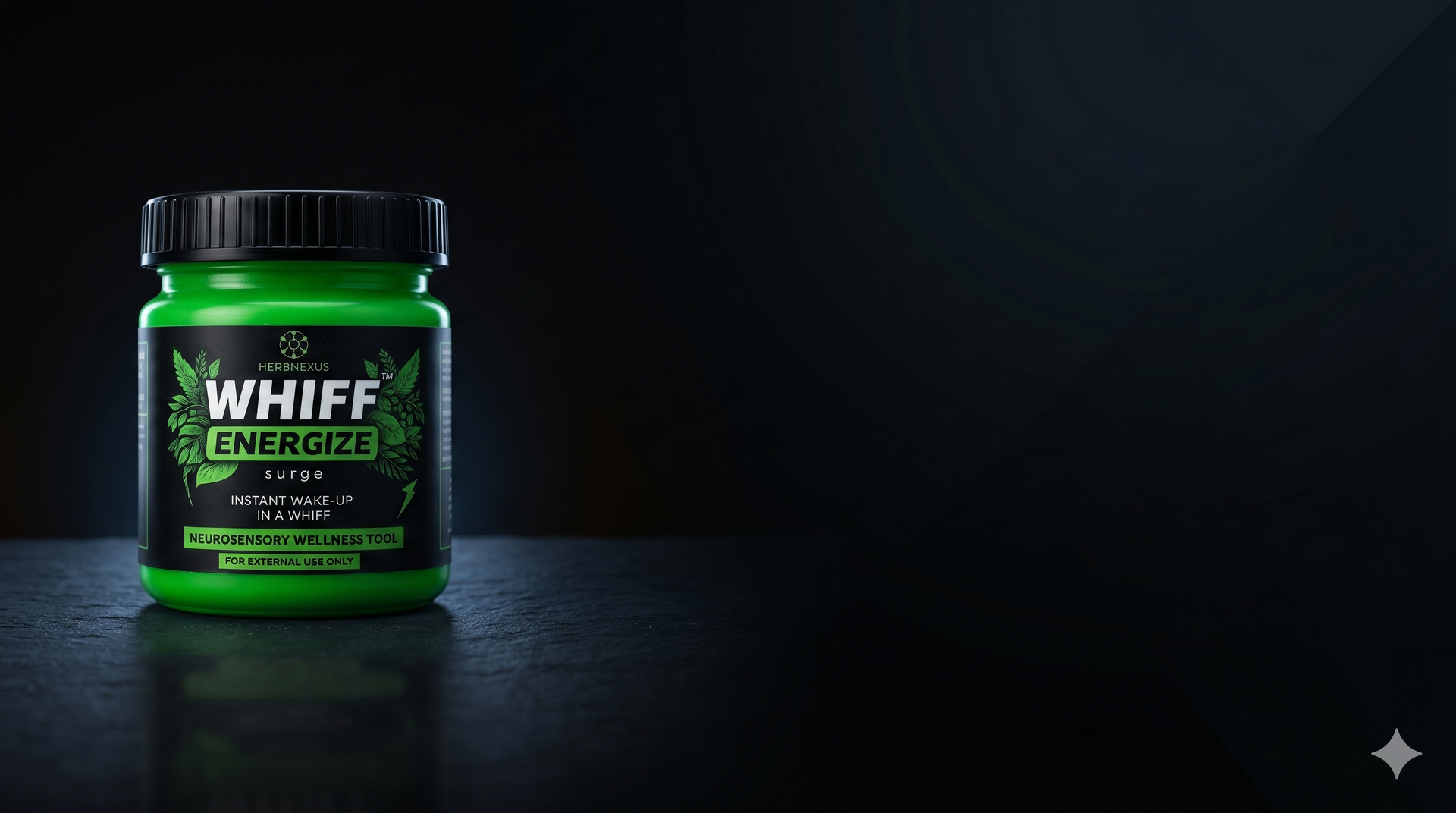
Whiff is a neurosensory state-switching system for switching your state on demand: a deliberate breath protocol, a sensory inhaler that anchors it, and the companion Whiff State OS app that turns it into a tracked, repeatable practice — not aromatherapy, not a supplement, not a medication.
Key takeaways
- There is no single Whiff breath — there is one protocol per target state.
- The breath is the mechanism; the scent is the anchor that cues it.
- Focus uses an even, balanced breath. Calm uses a longer exhale.
- Energy protocols are faster and carry a safety note — sit down first.
- The scent cue runs on every inhale for energy, at the start for focus and calm.
- Whiff State OS paces every protocol cycle by cycle.
What is a breath protocol?
A breath protocol is a fixed breathing pattern run on purpose to move you from one state to another. The pattern is the variable — how long you inhale, whether you hold, how long you exhale, and how many cycles you run. Breath is the lever because it is one of the few systems you can run automatically or take over on command. Change the pattern and you change how activated or settled you feel. A Whiff protocol pairs that pattern with a fixed scent cue, so the sequence becomes a signal your system learns to recognise.
Why a different breath for each state?
Because direction matters. A breath with a long, slow exhale moves you toward calm. A faster, fuller breath moves you toward activation. An even, balanced breath holds you steady for focus. Running the wrong pattern for the state you want works against you — a fast activating breath will not settle a busy mind, and a long exhale will not sharpen you for deep work. Whiff maps a specific pattern to each target state so the breath and the goal point the same way.
What are the focus protocols?
The focus protocols hold attention on one task and pull a scattered mind back to centre. They use even, balanced breathing — no long exhale, no fast inhale — to keep you steady rather than tipping you up or down.
Focus Mode — lock into one task
Pattern: Box Breathing 5-5-5-5 — inhale 5, hold 5, exhale 5, hold 5. 5 cycles, about 1 minute 40 seconds.
Use when: a deep-work session, trading or charts, studying or coding, before a focused work block.
Not for: when you are low on energy, or still carrying emotional residue — settle that first.
Command: Choose one task. No switching.
Focus Reset — re-centre, then enter focus
Pattern: Three Breath Reset — three deliberate cycles to drop the last context before the next. 3 cycles, about 1 minute.
Use when: mid-day mental drift, switching between contexts, before a hard conversation, priming before deep work.
Not for: when you are already in flow, or when you need full activation.
Command: Drop the previous context.
What are the energy protocols?
The energy protocols raise activation — from off to on, or from on to high. They are faster than the others and they carry a safety note, because activating breathwork can make you lightheaded. Sit or lie down before you run them. Never run an energy protocol standing, near water, or while operating a vehicle.
Wake Up — turn the system on
Pattern: Wake-Up Activation — a short activating sequence to clear a sluggish start. 1 cycle, about 1 minute.
Use when: you have just woken, morning grogginess, a low or sluggish start, before you begin the day.
Not for: when you are already active, or when you need full intensity — use Step Up.
Command: Complete this. Move immediately.
Safety: sit upright. Do not run this standing, lying down, near water, or while operating any vehicle.
Step Up — raise intensity now
Pattern: Activation — a longer, stronger sequence to step intensity up before a demand. 2 cycles, about 3 minutes.
Use when: before the gym, before filming, before a call or meeting, before a performance.
Not for: when you are tired or foggy — use Wake Up first; or when you are already wired.
Command: Complete this. Act within 60 seconds.
Safety: sit or lie down. Never run this near water, while driving, or anywhere a fall could cause injury.
What are the calm protocols?
The calm protocols move you down — from overloaded to controlled, from charged to empty, from active to shutdown. They share one mechanism: the exhale is longer than the inhale. A longer exhale is the pattern most associated with a settled nervous system, which is why all three calm protocols are built around it.
Calm Down — reduce internal noise
Pattern: Cyclic Sighing — a double inhale through the nose, then a long, slow exhale. 5 cycles, about 1 minute.
Use when: internal noise spikes, a pressure surge, racing thoughts, after overstimulation.
Not for: when you need emotional release — use Let Go; or when you need energy.
Command: Slow the exhale.
The pattern is not arbitrary. In a 2023 Stanford randomised controlled trial, five minutes a day of exhale-focused cyclic sighing lowered resting respiratory rate more than mindfulness meditation (Balban et al., Cell Reports Medicine, 2023). Whiff uses the same exhale-led mechanism as a fast, on-demand cue.
Let Go — release the charge
Pattern: Extended Exhale 1:2 — exhale roughly twice as long as the inhale. 6 cycles, about 1 minute 12 seconds.
Use when: after an argument, anger, frustration, emotional residue.
Not for: when you only need to settle and there is no charge to release; or when you need focus.
Command: No story. No thinking. Just release.
Evening Wind-Down — shut the system down
Pattern: 4-7-8 Breathing — inhale 4, hold 7, exhale 8. 4 cycles, about 1 minute 16 seconds.
Use when: the end of the day, when the day will not switch off, when you need to downshift.
Not for: daytime, or when you need to perform.
Command: Stay soft.
How do the seven protocols compare?
| State |
Protocol |
Breath pattern |
Cycles |
Duration |
Run it when |
| Focus |
Focus Mode |
Box Breathing 5-5-5-5 |
5 |
~1:40 |
Locking into one task |
| Focus |
Focus Reset |
Three Breath Reset |
3 |
~1:00 |
Switching contexts |
| Energy |
Wake Up |
Wake-Up Activation |
1 |
~1:00 |
A sluggish start |
| Energy |
Step Up |
Activation |
2 |
~3:00 |
Before a demand |
| Calm |
Calm Down |
Cyclic Sighing |
5 |
~1:00 |
Internal noise spikes |
| Calm |
Let Go |
Extended Exhale 1:2 |
6 |
~1:12 |
Releasing a charge |
| Calm |
Evening Wind-Down |
4-7-8 Breathing |
4 |
~1:16 |
End of the day |
Where does the scent cue come in?
The scent cadence changes with the direction of the protocol. For the energy protocols, the scent is taken on every inhale — the repeated signal supports stronger activation. For the focus and calm protocols, the scent is taken once, at the start, then the breath carries the rest. In every case the scent is the anchor, not the active ingredient. The breath does the work; the scent marks the moment so the sequence becomes repeatable.
Do I need the app to run a breath protocol?
You can run any of the seven with the inhaler and the pattern alone. Whiff State OS makes them paced and repeatable — it counts the cycles, times the inhale, hold and exhale for you, and tracks the practice over time. The pattern is the method; State OS is what turns a one-off breath into a conditioned cue you can reach for on demand.
Frequently asked questions
How many breath protocols does Whiff have?
Seven, grouped under three states: two for focus (Focus Mode, Focus Reset), two for energy (Wake Up, Step Up), and three for calm (Calm Down, Let Go, Evening Wind-Down). Each uses a different breath pattern matched to the state it switches you into.
Which breath protocol should I use to focus?
Use Focus Mode to lock into a single task — it runs box breathing, an even 5-5-5-5 pattern, for about 1 minute 40 seconds. If you are scattered and need to re-centre first, run Focus Reset, then enter focus.
What is the calm-down breath pattern?
Calm Down uses cyclic sighing — a double inhale through the nose followed by a long, slow exhale, run for about a minute. The longer exhale is the part of the pattern most associated with a settled state.
Are the energy protocols safe to do anywhere?
No. Activating breathwork can cause lightheadedness, so the energy protocols (Wake Up, Step Up) should be run sitting or lying down — never standing, near water, or while operating a vehicle. The calm and focus protocols do not carry this restriction.
Is a breath protocol a medical or therapeutic treatment?
No. Whiff is a general wellness tool, not intended to diagnose, treat, cure, or prevent any disease. A breath protocol is a sensory method for switching your state, not a treatment.
Whiff is a neurosensory state-switching system for switching your state on demand. The mechanism is a deliberate breath protocol; a sensory inhaler anchors it, and the companion Whiff State OS app turns it into a tracked, repeatable practice. It is not aromatherapy, not a supplement, and not a medication. State is a setting. Switch yours.
Run the method: The State Protocol. New here: What Is Whiff? Not aromatherapy: Whiff vs Aromatherapy.
Whiff is a neurosensory state-switching system. Whiff is not intended to diagnose, treat, cure or prevent any disease. Always consult a qualified practitioner before use if you have a medical condition.
About the author
Daksh Murkute, founder of Whiff (HerbNexus Private Limited). He writes on neurosensory science, breath protocols, and state-switching.
Connect: LinkedIn · X · Instagram