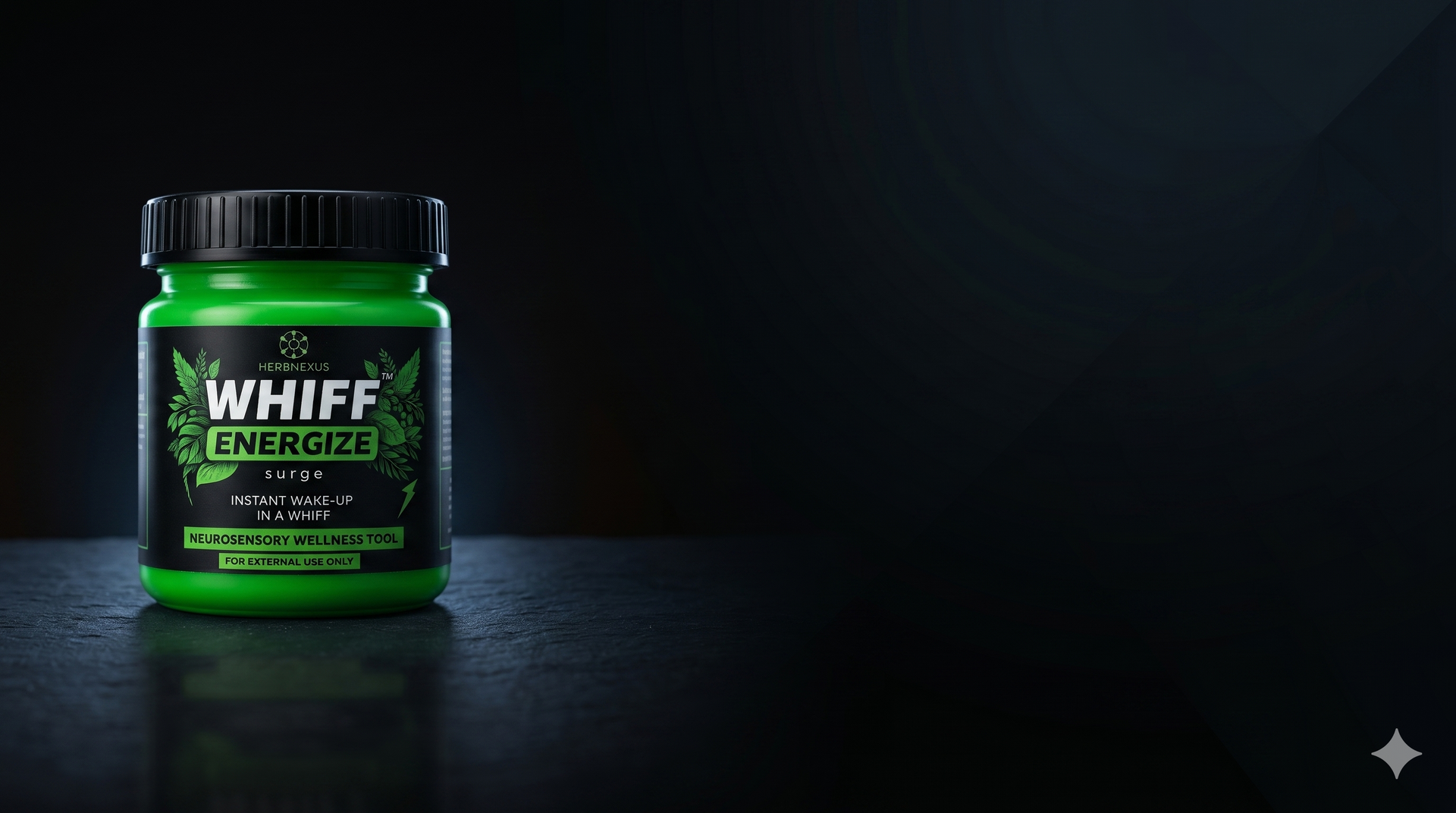
The State Protocol is Whiff's named method for switching your state on demand. It is a short, deliberate sequence — pause, take the scent cue, run the breath, execute. The breath is the mechanism that does the work, the scent is the anchor that cues it, and the Whiff State OS app structures the practice. A protocol you run, not a feeling you wait for.
Whiff is a neurosensory state-switching system: a deliberate breath protocol, a sensory inhaler that anchors it, and the companion Whiff State OS app that turns it into a tracked, repeatable practice — not aromatherapy, not a supplement, not a medication.
Key Takeaways
- The State Protocol is Whiff's named method for switching your state.
- Four steps: pause, take the scent cue, run the breath, execute.
- The breath is the mechanism; the scent is the anchor.
- A protocol works when motivation does not.
- Whiff State OS turns the protocol into a tracked practice.
- It runs in about 30 seconds, on command.
- State is trainable. The protocol is how you train it.
What Is the State Protocol?
The State Protocol is the method behind Whiff — a repeatable sequence you run to move from one mental and physical state to another. Most state tools are passive or slow: you drink the coffee and wait, you sit for the meditation, you diffuse the scent and hope. The State Protocol is different because it is deliberate and fast. You run it the way an athlete runs a warm-up or a pilot runs a checklist — a fixed procedure that produces a known result. Whiff defines and owns this method. The product is the inhaler; the State Protocol is what you do with it. For the full overview of the system, see what is Whiff.
Why a Protocol Beats Motivation
Motivation is unreliable. It arrives late, leaves early, and cannot be summoned on the day it matters most. State is different — it is trainable. Professional performers rarely wait to feel ready before they act; they run a procedure that signals the body and mind to move. Athletes have warm-up routines. Pilots have checklists. Military units have preparation sequences. The common thread is that a protocol works when emotions do not. The State Protocol applies the same logic to the moments that decide your output: the reset before a high-stakes meeting, the lock-in before deep work, the downshift after a hard call. You do not wait for the right state. You run the protocol and enter it. This is the difference between a state shift and a mood.
The Four Steps of the State Protocol
The method is deliberately simple — a sequence short enough to run anywhere, repeatable enough to become an anchor.
-
Pause. Stop the current task. Mark the transition.
-
Take the scent cue. Open Whiff. The scent primes and anchors the breath you are about to run.
-
Run the breath. A deliberate breathing sequence — the active mechanism. This is what does the work.
-
Execute. Move into the task in the state you came for.
Run enough times, the sequence becomes conditioned — the cue and the state fire together. The detailed mechanics are in the 3-breath protocol.
Why Breath Is the Mechanism
Breath is the active lever because it is one of the few bodily systems that is both automatic and voluntary — you can override it on command. How you breathe maps onto measurable shifts in physiological arousal. In a randomized controlled study of brief daily breathing practices, researchers found that exhale-emphasized breathing produced a greater reduction in respiratory rate and physiological arousal than meditation over a one-month period (Balban et al., Cell Reports Medicine, January 2023). This is why the State Protocol is built on the breath rather than the scent. The breath is what changes the state. Everything else in the protocol exists to make that breath repeatable.
Why Scent Is the Anchor
Scent is the fastest sensory cue available, which is why the State Protocol uses it to anchor the breath. Olfactory signals bypass the thalamic relay that other senses route through, reaching the brain's emotion and memory centers almost immediately — by one account, only two synapses separate the olfactory nerve from the amygdala (ScienceDirect, Olfactory Memory overview). As Harvard neuroscientist Venkatesh Murthy put it:
"The olfactory signals very quickly get to the limbic system."
A consistent scent makes an effective conditioning cue: pair it with the breath enough times and it begins to trigger the sequence on its own. A bright, cooling signal also engages the trigeminal nerve, adding an alerting edge. The scent is never the active ingredient — it is the signal that fires the protocol.
How State OS Completes the Protocol
A method only works if you actually run it. Whiff State OS is the companion app that turns the State Protocol from a one-off inhale into a tracked practice — guided rituals, a breath ring that paces the sequence, daypart-based state shifts, streaks, and milestones. Where the inhaler delivers the signal, State OS structures and sustains the practice across weeks of use, which is when the conditioning takes hold. This is the layer competitors cannot replicate by copying the jar. The protocol is the method; State OS is what makes it stick.
State Protocol vs Other State Tools
The State Protocol is not the only way people try to change their state. It differs from the common alternatives less in intent than in mechanism and design.
|
State Protocol |
Caffeine |
Meditation |
Aromatherapy |
| What does the work |
A deliberate breath, scent-anchored |
A stimulant compound |
Sustained attention practice |
The essential oil |
| Time to run |
About 30 seconds |
20–45 minutes to take effect |
10+ minutes |
Passive / ambient |
| On demand |
Yes — run it anywhere |
Delayed, one-directional |
Requires time and quiet |
Diffuse and wait |
| Repeatable practice |
Tracked in Whiff State OS |
None |
Self-directed |
None |
| Positioning |
State-switching for performance |
Stimulation |
General practice |
Relaxation and mood |
For the full breakdown of the aromatherapy distinction, see Whiff vs aromatherapy.
FAQ
What is the State Protocol?
The State Protocol is Whiff's named method for switching your state on demand — a four-step sequence: pause, take the scent cue, run the breath, execute. The breath is the mechanism, the scent is the anchor, and the Whiff State OS app structures the practice.
How long does the State Protocol take?
About 30 seconds. It is built to run anywhere — between meetings, before deep work, after a hard call — without needing time, quiet, or setup. That is the point: a protocol you can run on command.
Is the State Protocol the same as breathwork?
The breath is the mechanism inside the State Protocol, but the protocol adds the scent anchor and the State OS practice layer. Breathwork courses ask you to learn and remember a technique. The State Protocol is conditioned by a fixed cue, so it becomes automatic.
Do I need the app to run the State Protocol?
You can run the four steps with the inhaler alone. Whiff State OS makes the practice repeatable and tracked — guided rituals, a breath ring, streaks — which is what builds the conditioning over time.
Is this a medical or therapeutic protocol?
No. Whiff is licensed in India as an Ayurvedic Proprietary Medicine, but it is not intended to diagnose, treat, cure, or prevent any disease. The State Protocol is a sensory method for switching your state, not a treatment.
Whiff is a neurosensory state-switching system for switching your state on demand. The mechanism is a deliberate breath protocol; a sensory inhaler anchors it, and the companion Whiff State OS app turns it into a tracked, repeatable practice. It is not aromatherapy, not a supplement, and not a medication. State is a setting. Switch yours.
Whiff is a neurosensory state-switching system . Whiff is not intended to diagnose, treat, cure or prevent any disease. Always consult a qualified practitioner before use if you have a medical condition.
About the author
Daksh Murkute, founder of Whiff (HerbNexus Private Limited). He writes on neurosensory science, breath protocols, and state-switching.
Connect: LinkedIn · X · Instagram